
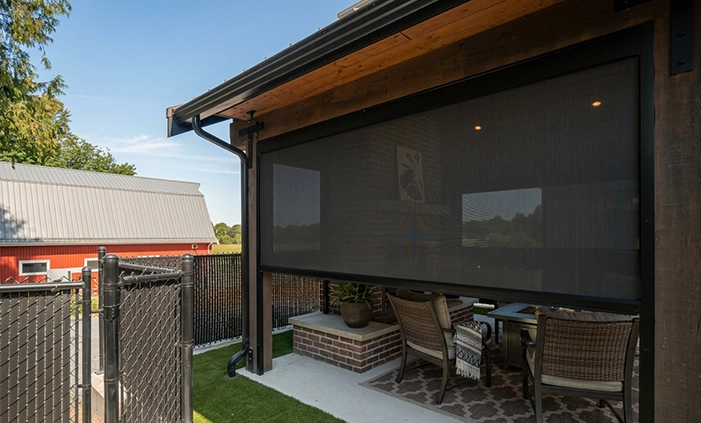
Choosing between motorized screens and traditional screens can feel like a small home decision. Then you start comparing prices, controls, installation, daily use, and maintenance. Suddenly, that “simple screen” has a lot going on.
Motorized screens move up and down using a motor, while traditional screens usually stay fixed or require manual movement. Motorized screens offer more control and convenience, while traditional screens cost less and have fewer moving parts.
Below, we’ll compare how both options work, where they make sense, what they cost, and what you should consider before choosing one.
What Are Motorized Screens?
Motorized screens use an electric motor to raise and lower the screen material. You can usually operate them with a wall switch, remote, or compatible smart home control.
When raised, the screen rolls into a housing above the opening. This keeps it out of sight when you want an open view or easy access through the space.
Motorized screens are often installed on patios, porches, lanais, garages, and other large openings. They can help block insects while still allowing fresh air through. Some motorized screen systems offer different mesh choices for insects, sunlight, privacy, or airflow. Available options depend on the screen system and manufacturer.
What Are Traditional Screens?
Traditional screens are the simpler option most people already know. They are commonly fixed inside frames or moved by hand.
You may see them on windows, doors, porches, and smaller outdoor openings. There is no motor, remote, or electrical connection involved.
That simple design can be a major benefit. If you mainly want to keep bugs outside, a standard screen may do the job without adding extra features.
Motorized Screens VS. Traditional Screens at a Glance
The biggest differences come down to operation, opening size, appearance, installation, and cost.
| Feature | Motorized Screens | Traditional Screens |
| Operation | Motor-powered | Fixed or manual |
| Controls | Switch, remote, or compatible controls | Operated by hand |
| Large openings | Often a good fit | May be less practical |
| Hidden when unused | Yes, with retractable systems | Usually no |
| Installation | More involved | Usually simpler |
| Upfront cost | Higher | Lower |
| Moving parts | Motor and related components | Few or none |
| Convenience | High | Basic |
Neither option wins every category. The right choice depends on where the screen will go and how you plan to use it.
The Biggest Difference is Convenience
Imagine sitting on your patio when mosquitoes decide you are tonight’s dinner special. With a motorized system, you can lower the screens without walking around and manually closing several panels.
That convenience matters even more with large openings. A motor can move a screen that would otherwise be awkward to handle by hand.
Traditional screens require more manual effort, but that may not be a problem. If the screen stays in place most of the year, powered operation may not offer much added value.
Quick Tip: Think about how often you will open and close the screen. Frequent daily use can make motorized operation more useful.
Motorized Screens Work Well With Large Openings
Large patios and covered outdoor spaces can be difficult to screen with standard framed panels. Multiple fixed sections may interrupt the view and create extra framing across the opening.
Motorized screens can cover wide openings while retracting when they are not needed. This gives you more flexibility when moving between indoor and outdoor areas.
For example, you might keep the screens raised during a cool morning. When insects become active later, you can lower them.
Traditional Screens Keep Things Simple
Not every opening needs a motor. Sometimes a basic screen is exactly what makes sense.
Traditional screens have fewer mechanical components that can wear out. There is no motor, electrical control, or remote to think about.
They can also be easier to repair in many cases. A damaged section of mesh may be replaced without dealing with powered equipment.
Fact: Traditional screens are generally less expensive because their design requires fewer mechanical and electrical components.
How do the Costs Compare?
Motorized screens usually cost more upfront than traditional screens. You are paying for the motor, controls, housing, screen material, installation, and other system components.
The final price can vary based on opening size, mesh type, control options, and installation conditions. Larger or more complex openings generally require more material and labor.
Traditional screens normally have a lower starting cost. That makes them useful when you need to screen several standard-size openings without paying for powered operation. Compare the full installed cost rather than the screen material alone. Motorized systems may require electrical work or additional mounting components.
What About Maintenance?
Both screen types need basic care. Dust, pollen, dirt, and outdoor debris can collect on the mesh over time.
Traditional screens are fairly simple to inspect. Look for holes, loose edges, bent frames, or worn mesh.
Motorized screens need those same checks, plus attention to their moving components. Tracks should remain clear, and the screen should move without unusual resistance.
Warnings: Never force a motorized screen that appears stuck. Continuing to operate a blocked system may damage the screen, track, or motor.
Do Motorized Screens Provide Better Insect Protection?
Not automatically. Insect protection depends heavily on the mesh, fit, installation, and condition of the screen.
A well-fitted traditional screen can block insects very effectively. A motorized screen can do the same when it closes correctly around the opening.
The advantage of motorized screens is not simply “better bug protection.” Their main benefit is giving you that protection when you want it and letting you retract the screen when you do not.
What About Airflow and Visibility?
Both options can allow airflow while helping keep insects outside. The amount of air and visibility depends largely on the mesh you choose.
Some mesh is designed for clearer views and stronger airflow. Other types use a tighter weave that may provide more shade or privacy but reduce airflow.
So, do not compare screens based only on whether they are motorized or traditional. Compare the actual mesh options too.
Which Option Should You Choose?
Motorized screens may make more sense if you have large openings, use your outdoor area often, or want screens that disappear when they are not needed.
Traditional screens may be better if your openings are smaller, your screens rarely need to move, or keeping the project cost lower is your main concern.
Ask yourself these questions before deciding:
- How large is the opening?
- How often will I move the screen?
- Do I want the screen hidden when unused?
- How much maintenance am I comfortable with?
- What is my installation budget?
Your answers should make the choice much clearer.
Conclusion
Motorized and traditional screens solve the same basic problem in different ways. Both can help keep insects out while allowing air into a covered outdoor area.
Motorized screens provide powered operation, retract when unused, and work well for many large openings. Traditional screens offer a simpler and usually less expensive solution with fewer mechanical parts.
If you are considering motorized screens for your property, Harbor & Shade can help you review your space and choose a screen setup that fits how you plan to use it.